Cruising down their favorite groomed runs, intermediate skiers and snowboarders will carve a hard edge to avoid getting near a resort gate that appears like a wormhole to another galaxy. Ropes and signs warn them with stale legalese that they assume all risk for what lies beyond, with nary a glimpse of the actual terrain. But like a moth to a flame, we pause, consider and wonder.
There’s no such thing as ‘safe.’
Before reading further, know that there is nothing in a ski resort, mountain, or anywhere that is ‘safe.’ Safe means free from risk or harm, something that does not exist in the context of skiing or life. In the context of terrain within a ski resort, guests are expected to manage the risks based on their abilities and conditions. This is especially true on off-piste runs and through the trees or gates. "Know before you go" (or KBYG) is a common mantra for outdoor enthusiasts. For those that plan (or dream) of spending more time in the backcountry or simply want to understand the risks in order to better manage them, Utah Avalanche Center and other organizations offer popular avalanche education courses. Being "Avy-Certified" (or re-certified) is considered a badge of honor in the Wasatch.
Many gates lead to terrain that, by any reasonable measure, is for experts only. Almost all terrain beyond a gate is designated black or double black. But not all black runs are the same, and, as many agree, black trails at one resort can be much more challenging at another. Some are steep; others are narrow; they might have rocks or trees, or lead to a place not regularly patrolled. However, there are several areas at Utah resorts where such designated terrain is more manageable, and a lot of fun, for intermediate skiers and snowboarders.
Powder Mountain
“Two roads diverged in a wood, and I took the one less traveled by, and that has made all the difference.” —Robert Frost, The Road Not Taken
Getting off the beaten path at a ski resort can lead not only to great snow but to a way to experience the mountain differently. Powder Mountain has dotted its slopes with artistic installations providing guests with a full complement of sensory experiences. One of the best is Listen, part a collection by Davina Semo of bronze bells perforated with holes allowing light and sound to call intrepid and curious skiers and snowboarders off-piste.
As the wind brushes by your cheek exiting the Timberline lift, u-turn skiers’ left opposite the Ski Patrol hut and head toward the grove of trees. Entering them, wafts of bark and the remnants of birch may tickle your nose. Stop and visualize the most-skiable path; wide traverses may, actually, be best to locate any or all of the three Bells ringing and shimmering in this expanse covering more than two football fields. Exit skiers’ left onto Sidewinder.
Deer Valley
Here be dragons! Medieval map designation
As you ride up the Empire chairlift at Deer Valley Resort, skiers (Deer Valley is a skier-only resort) look to the left and see trees, several steep chutes and another set of trees. That entire section is commonly referred to as Daly Chutes and broken down into sections Quincy Knoll, X-Files, Daly Chutes, Daly Bowl and Anchor Trees, and accessed from the ridgeline. It is accessible from a gate at the top of Orion.
Some sections, including Daly Chutes and Bowl, are steep and gnarly and require expert skills, but intermediate skiers (again, assess your ability and comfort level) might consider Anchor Trees, a great area to work on tree skiing due to the generous spacing and gentle pitch below the traverse. X-Files is a bit more challenging, with some tighter trees and increased pitch, but still within the reach of many upper-intermediate skiers, especially in fresh snow.
Alta
“The scariest moment is always just before you start.” ―Stephen King
Alta Ski Area embraces you like a warm hug before it sends you off to fend for yourself. There are several gates at Alta that intermediate skiers could manage, especially those where you can see the terrain from the lift or the gate, such as Ballroom and Catherine’s.
At the top of Collins lift, head right toward High Main Street, a short, steep black pitch that is often a bit (sp)icy. At the top left is the gate to the Ballroom, the large BLUE bowl that sits beneath Mt. Baldy. With fresh snow, skiers sachetacross the traverse dipping in wherever the music takes them and dancing to the bottom.
Another great option is Last Chance in Catherine’s, the northern boundary line terrain accessed via a gate, boot pack and traverse at the top of Supreme. The effort is worth it.
At the top of the lift, pass through the gate and kick off your skis. It’s time to boot pack approximately 20 yards toward the trees at the top of Catherine Chutes. For many, this is the hardest part. Put your skis back on and traverse along the ridgeline (it is a bit tight at the beginning) until the terrain opens up into a small bowl that dog-legs left up and over a knoll and another and another until you eventually reach the cat track below.
Eagle Point
“Danger, Will Robinson!” Robot, Lost in Space’
Eagle Point is a powder paradise, and some of the best is tucked away where no one would expect it, in the upper (easier) Skyline Lodge area. The runs here are tailor-made for families and new or returning skiers and snowboarders. With wide, tree-lined trails atop the Tusher Mountains, it stands as one of the most scenic “beginner” ski areas in Utah.
It's also one of the quietest resorts, which means that, if you know where to go, guests who want to give powder skiing a try can find it…even after lunch. As you leave the Monarch Triple Chair, head right toward the trees. If there are no tracks in the snow, make haste! Follow the boundary line past Full Moon, Hannah’s Haze, Quakies and any backcountry gates. The short traverse opens up to the right into the beautiful, low-angle area called Teddy’s Twist. The boundary line curves downward from there. It’s go time!
Teddy’s is more saucer than bowl, but because most skiers and snowboarders are on the bunny hill, terrain park or down below gunning the steeps, this is the uncut gem most dream about. If you’re there on a Powder Friday, you may buy property nearby and never leave. You won’t know whether to shout or keep as quiet as possible, but you’ll likely look over your shoulder on the next lap and the next.
Brighton
“Abandon all hope, ye who enter here.” ―Dante, The Divine Comedy
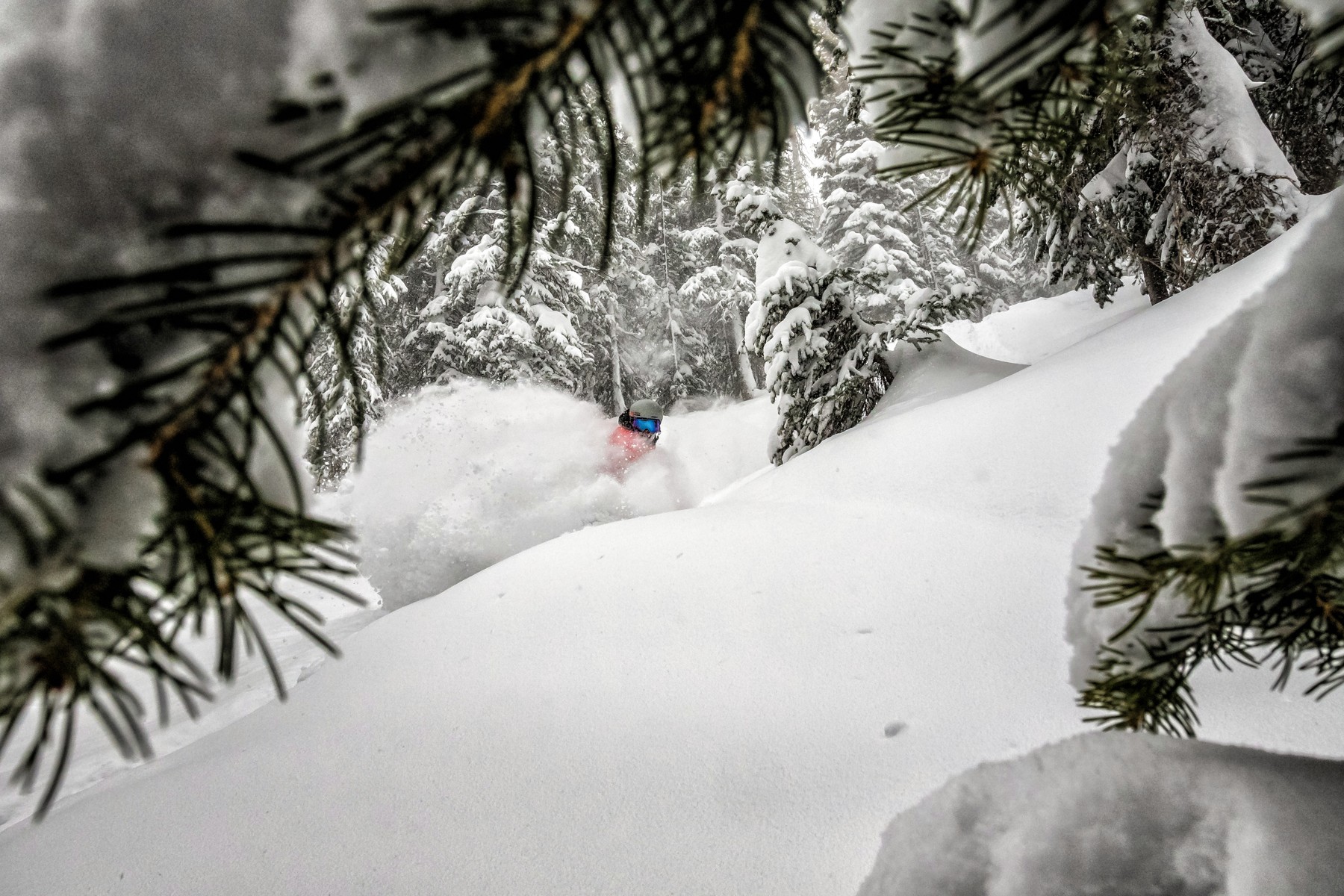
If there’s fresh snow, and you want to try some tree skiing at Brighton, those off Snake Creek Express are some of the best and most accessible for intermediate skiers comfortable in powder. (Note: If this section has not received fresh snow and has carved-out moguls, it is NOT recommended for anyone but experts.)
Take the high-speed quad to the top and exit left. Follow the gentle ridgeline traverse past Pioneer to Sunshine, a wide, green run. Enjoy a lap on this (typically groomed run) if you want to gauge the pitch and terrain. Along the right-hand side sits a copse of mostly well-spaced evergreens that runs almost the entire length of Sunshine. Skiers and snowboarders can enter, and exit, these trees at any point, allowing them to dip their toes in to give tree skiing a try.
Go SLOWLY through this section; aside from trees, there are giant boulders and other obstacles, including other skiers and snowboarders. This section is best and easiest with fresh snow, ferrying guests through the giant spruces and allowing them to see and “pop” out back onto Sunshine, Thor, or any of the other well-groomed nearby runs. With some experience and comfort in this section, take the traverse at the top of Sunshine and venture further through the trees, where there is typically more untracked snow, before dropping in.