Summer in Utah is amazing. The endless biking flow trails, ridgelines to run, restaurants, and breweries open for patio season always make summer fun. When the temperatures start to drop, many of my patients ask me what they can do to prep for skiing without taking the fun out of summer activities. The evidence is clear that strength training is irreplaceable for improving base strength required to ski hard all season long (more info on why it isn’t enough here), but what about cardio activities that translate well to skiing?
Some people choose to mountain bike like it’s going out of style. Others dive deep into trail running, hiking, or golf and pretend that counts as strength training. And some Utahns are wild, rollerblading around Liberty Park, wearing sweatbands, channeling pure 1980s ski-movie energy, imagining they are skating up to the base of the Collins chair at Alta Ski Area.
Unsurprisingly, not every off-season sport is created equal when it comes to improving your ski skills for next winter. If your goal is not to feel like Bambi on ice for the first few days of the season, then choose your off-season activities wisely.
So let’s break down the top contenders of offseason activities, from #4 to the sport that reigns superior.
#4 – Soccer
Soccer, an international favorite pastime, and the unsung hero of reactive athleticism.
Playing soccer requires similar physical demands through the lower extremity (known as leg-axis stability) when it comes to the movements of cutting, pivoting, and stabilizing the knee during fast directional changes.
During both soccer and skiing, the hip and core work together to stabilize the leg as a whole, a skill that can translate from one sport to the other. Soccer also provides external cues for quick reactions, similar to picking your line while moving fast down a ski run.
While it’s far from a perfect parallel, soccer does have a place in helping maintain the foundational movement patterns and quick reaction timing required while skiing.
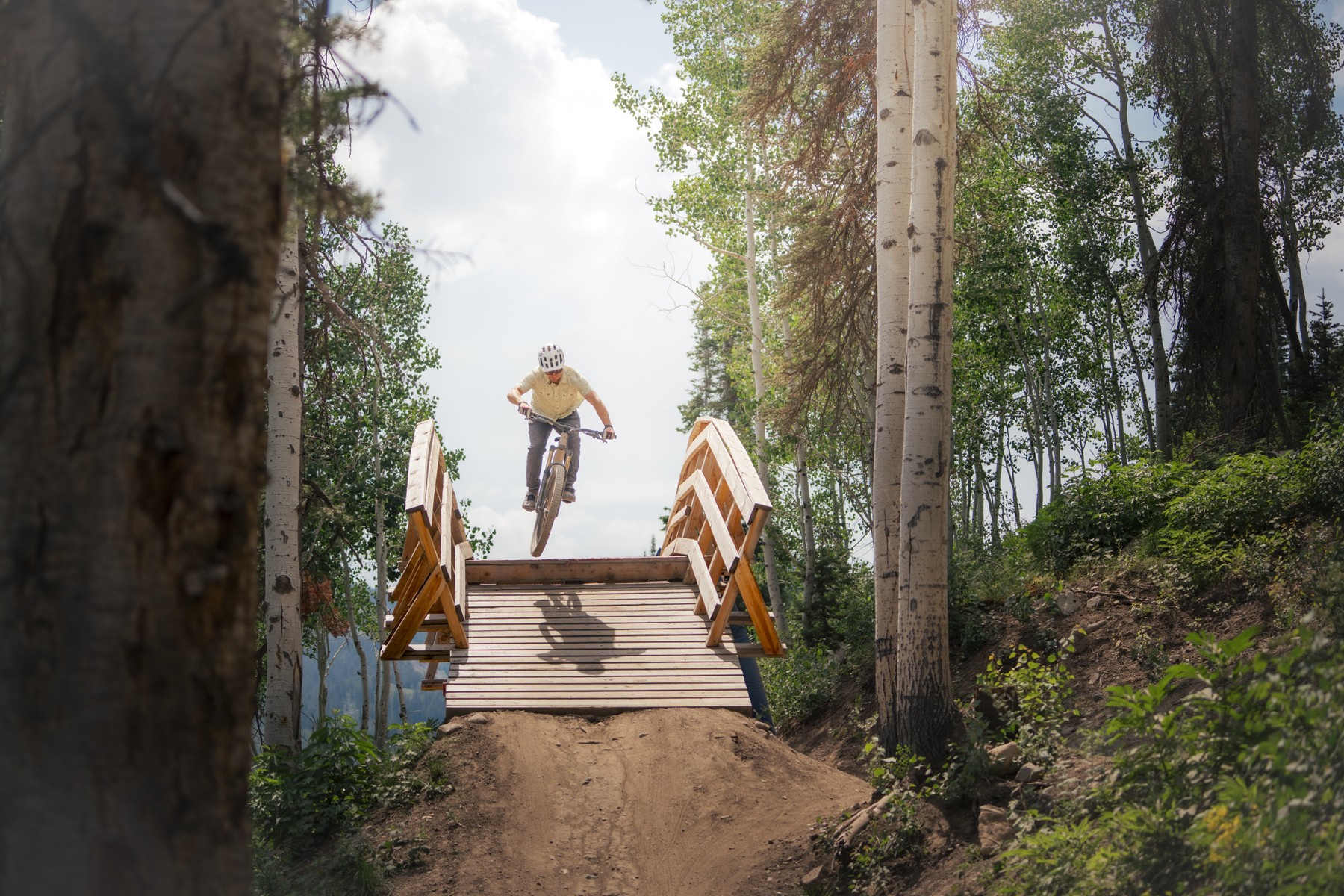
#3 – Mountain Biking
If you’ve spent any time in Utah in the summer, you’ve probably seen some of the single-track mountain biking trails that make Utah a favorite destination for flow seekers. Whether you’re here for the berms of Solitude Mountain Resort, the rocky technical terrain that Brian Head Mountain Biking has to offer, or the cross-country style trails available at Park City Mountain, there is something for everyone here. If, while riding, you feel like you’re kind of maintaining some of the things your body needs for skiing, you aren’t wrong.
Mountain biking and skiing both require similar leg strength demands, but with different emphasis. Mountain biking utilizes more concentric (pedaling phase) and isometric muscle contractions (while on the downhill phase) of the hamstrings, quads, and glutes. Skiing, on the other hand, requires significant eccentric muscular strength, mostly of the quads and glutes. Though the muscles are similar, the types of muscle activation differ, making it a good parallel, but by no means can it be your only off-season training activity.
Another way in which mountain biking and skiing are similar is the neurocognitive challenges of both sports. When comparing downhill mountain biking to alpine skiing, neurocognitive demands refer to the brain’s split-second work: processing visual information, selecting movement strategies, maintaining balance, and adapting to unpredictable terrain. The mental workload is surprisingly similar in both sports, which is why in this domain, they work well for cross-training.
Though mountain biking is not skiing, it meets the same adrenaline needs while keeping your mind-body connection sharp and strong.
#2 – Trail Running
The Wasatch Mountains are full of picturesque ridgelines to run. Almost every evening, you can see the west-facing slopes of the Wasatch speckled with little lights as motivated trail runners descend the rocky faces after dark, training their bodies and minds for the ski season ahead.
Trail running utilizes glutes, quads, and hamstrings in a way not too dissimilar to that of skiing. Though the cyclic motion of concentric and eccentric activation patterns is significantly shorter in duration than it is during skiing, the eccentric control for downhill trail running comes closer to that of skiing than any other sport discussed in this blog yet. Skiing still requires significantly higher amounts of eccentric control through the quads and glutes, and skiers experience much quicker neuromuscular fatigue, but it’s still a good summer season alternative.
Similar to skiing and mountain biking, trail running also requires significant neurocognitive control in order to execute without injury. Dancing down rocky faces uses your quick reflexes to safely traverse the uneven terrain. Any downhill trail runner will tell you, it takes balance, line planning, and precision in each step in order to run downhill smoothly, which is why it is ranked #2 for the most applicable offseason sports to skiing.
#1 – Inline Skating (Rollerblading)
Imagine this: it’s 1987. You’re wearing neon short-shorts, a red, white, and blue sweatband, and white rimmed sunglasses. You’re blasting pop and carving turns around Liberty Park like you’re training for the next TGR film.
Rollerblading or Inline skating is by far the closest dry-land activity to match the physical demands of alpine skiing. Multiple studies directly comparing the two sports state that the leg-axis symmetry, trunk involvement, and loading patterns during turns are strikingly similar. EMG studies show moderate to high activation of the same muscle groups you rely on in slalom ski racing, including quads, hamstrings, glutes, and trunk stabilizers.
The turning mechanics, the pressure on the outside ski (or skate), and the neuromuscular demand all align. Though at a slower pace while rollerblading than during alpine skiing. While inline skating, you’re training the synergies and recruitment patterns of a carved ski turn, just with shorter shorts on.
If you watch the training practices of any Olympic skiers during the off-season, you’re likely to see at least one video spoof on their Instagram of rollerblading, and that’s for good reason. In every measurable way, inline skating blows every other off-season sport out of the water.
So this fall, make the most of your off-season training by grabbing your inline skates, wrist guards, short neon shorts, and heading to the smoothest bike path you can find because each mile you spend inline skating translates into better early-season skiing.
References
-
Muscle Activity in the Slalom Turn of Alpine Skiing and in-Line Skating. Zeglinksi CM, Swanson SC, Self BP, Greenwald RM. International Journal of Sports Medicine. 1998;19(7):447-54. doi:10.1055/s-2007-971943.
-
Inline Skating as an Additional Activity for Alpine Skiing: The Role of the Outside Leg in Short Turn Performance. Cigrovski V, Očić M, Bon I, Matković B, Šagát P. International Journal of Environmental Research and Public Health. 2022;19(3):1747. doi:10.3390/ijerph19031747.
-
The Influence of Geographic Variations on the Muscular Activity in Selected Sports Movements. Clarys JP, Alewaeters K, Zinzen E. Journal of Electromyography and Kinesiology : Official Journal of the International Society of Electrophysiological Kinesiology. 2001;11(6):451-7. doi:10.1016/s1050-6411(01)00020-7.
-
More Than Just a Side Effect: Dynamic Knee Valgus and Deadbug Bridging Performance in Youth Soccer Players and Alpine Skiers Have Similar Absolute Values and Asymmetry Magnitudes but Differ in Terms of the Direction of Laterality. Hanimann J, Ellenberger L, Bernhard T, et al. Frontiers in Physiology. 2023;14:1129351. doi:10.3389/fphys.2023.1129351.
-
Muscle Control in Elite Alpine Skiing. Berg HE, Eiken O. Medicine and Science in Sports and Exercise. 1999;31(7):1065-7. doi:10.1097/00005768-199907000-00022.
-
Muscle Activity in Wedge, Parallel, and Giant Slalom Skiing. Hintermeister RA, O'Connor DD, Lange GW, Dillman CJ, Steadman JR. Medicine and Science in Sports and Exercise. 1997;29(4):548-53. doi:10.1097/00005768-199704000-00018.
-
Fatigue-Induced Changes in Electromyographic Activity After Repeated Racing Turns: A Pilot Study. Chollet M, Samozino P, Morel B, et al. European Journal of Applied Physiology. 2025;125(5):1423-1435. doi:10.1007/s00421-024-05691-0.
-
Quadriceps Muscle Function During Recreational Alpine Skiing. Kröll J, Wakeling JM, Seifert JG, Müller E. Medicine and Science in Sports and Exercise. 2010;42(8):1545-56. doi:10.1249/MSS.0b013e3181d299cf.
-
Involvement of Eccentric Muscle Actions in Giant Slalom Racing. Berg HE, Eiken O, Tesch PA. Medicine and Science in Sports and Exercise. 1995;27(12):1666-70.
-
Muscular Fatigue and Quadriceps-to-Hamstring Ratio in Alpine Skiing in Women Over 40 Years. Hermann A, Christl V, Hastreiter V, et al. International Journal of Environmental Research and Public Health. 2023;20(8):5486. doi:10.3390/ijerph20085486.
-
Changes in Quadriceps Muscle Activity During Sustained Recreational Alpine Skiing. Kröll J, Müller E, Seifert JG, Wakeling JM. Journal of Sports Science & Medicine. 2011;10(1):81-92.
Is It Possible to Voluntarily Increase Hamstring Muscle Activation During Landing From a Snow Jump in Alpine Skiing? - A Pilot Study. Färber S, Heinrich D, Werner I, Federolf P. Journal of Sports Sciences. 2019;37(2):180-187. doi:10.1080/02640414.2018.1488423.